
Years of unpaved roads mean endless suffering during the monsoon in Taltali.
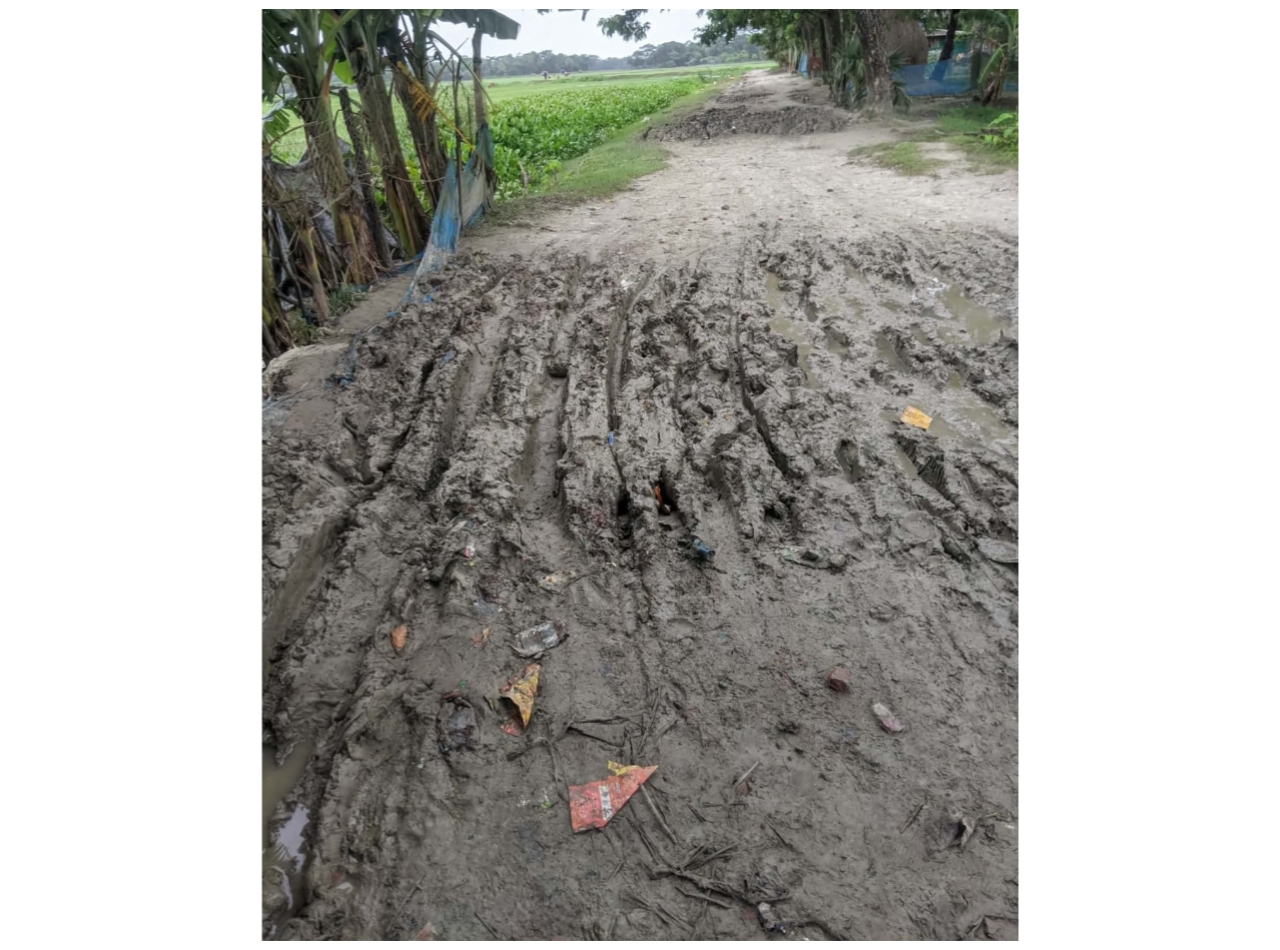 The road stretching from Mathkhola to Charpara Government Primary School in Barguna’s Taltali Upazila stands as a symbol of a locality neglected by development. Left in an unpaved and dilapidated state for a long time, the road turns into a quagmire of mud and water with even the slightest rainfall. Despite years of such hardship, the lack of a permanent solution raises the question: when will the local people's suffering finally end?
Locals complain that although this road is a vital link for the community, there has been a lack of effective initiatives to improve it. During the monsoon season, mud and water accumulate in various sections, making it difficult even to walk, let alone drive; vehicular movement becomes nearly impossible in many places.
The road serves Charpara Government Primary School, a secondary school, a Dakhil Madrasa, a mosque, a temple, and a polling station, resulting in heavy daily traffic.
According to locals, over a hundred students commute to their educational institutions daily, wading through mud and water. During the monsoon, the road's condition deteriorates so severely that many students fail to reach school on time. Guardians report that this persistent situation is negatively affecting student attendance and regular studies.
As the area relies on agriculture, the road's poor condition directly impacts farmers. They are forced to spend extra time and money transporting their produce from the fields to local markets.
Farmers complain that transporters are often reluctant to pick up goods due to the road's poor state. Consequently, they are compelled to pay higher fares, driving up transportation costs alongside production expenses. Ultimately, if the market price falls short of expectations, the farmers' profits dwindle.
Locals also allege that the road's dilapidated state poses significant risks regarding emergency healthcare.
The mud-filled road becomes a major obstacle when there is an urgent need to transport critically ill patients, the elderly, or pregnant women to the hospital quickly. Locals report that during the monsoon season, many vehicles—including ambulances—refuse to enter the road. Consequently, transporting patients to the main road requires significant extra time and effort.
Residents ask: if a single road causes delays in accessing emergency medical care, how much longer must they wait for its development?
Polling stations are located near the road, and ordinary citizens rely on this route during elections and other critical times. Yet, there is growing resentment among locals that such a vital link has remained unpaved and in a dilapidated state for so long.
They question why this road—essential for connectivity regarding education, agriculture, religious institutions, healthcare, and elections—has not undergone permanent renovation despite the passage of time.
Although locals have repeatedly urged the relevant authorities to repair and pave the road, no visible, permanent solution has been implemented. Residents also seek clear answers regarding whether any projects or funds were previously allocated for the road, and if so, to what extent those funds were actually utilized.
They insist that instead of merely making the road temporarily passable by dumping soil or bricks, authorities must take steps to pave it permanently and sustainably.
Local residents state they are not seeking special privileges; they simply expect a safe, durable, and usable road. Immediate development is necessary to facilitate students commuting to school, farmers marketing their produce, and the transport of patients in emergencies.
Residents ask: if a single road hinders a community's education, agriculture, healthcare, and normal daily life, how much longer must they wait for development initiatives to begin?
Consequently, locals are demanding an on-site inspection of the road—stretching from Mathkhola to Charpara Government Primary School—followed by necessary action and a long-term plan to pave it permanently.
However, the investigative aspect of this report would be further clarified by obtaining statements from the Upazila Engineering Department and relevant public representatives regarding the road's current poor condition, any past projects or fund allocations, and the authorities' future plans.
E-mail: thedailyprimenewsbd@gmail.com
All rights reserved © The Daily Prime News (International Newspaper And Media Company) প্রিন্ট করুন
 সেভ করুন