


Dhaka 9:27 am, Tuesday, 27 October 2026

A Mosque and a Temple in the Same Courtyard for 41 Years: A Unique Example of Harmony in Narail

In the village of Mahishkhola, within the Narail Municipality, a mosque and a temple stand side-by-side in the same courtyard. For 41 years, members of the Muslim and Hindu communities have been carrying out their respective religious practices here. This environment, built upon mutual respect, cooperation, and coexistence, has become a local model of harmony.

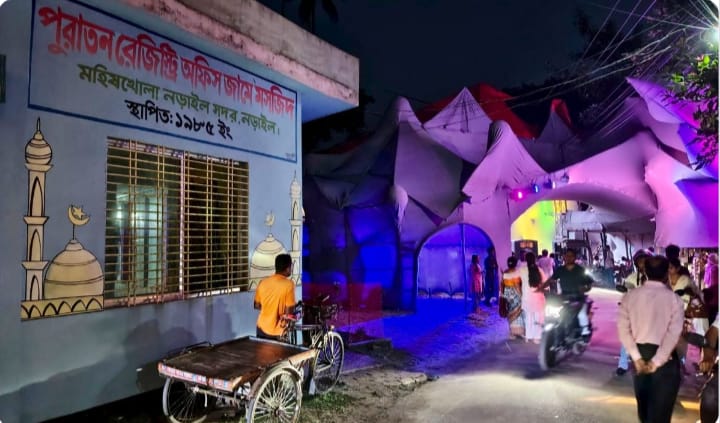
Regular religious activities take place at the Mahishkhola Old Registry Office Jame Mosque and the Mahishkhola Sarbajanin Puja Mandir, both located along a road bordering the Chitra River. While the *azan* (call to prayer) and *namaz* (prayers) are observed in the mosque, *puja* (worship rituals) are conducted in the temple. According to locals, musical instruments in the temple are silenced during prayer times, and rituals resume once the prayers conclude.

On Saturday (October 17), during the Durga Puja festival, organizers were seen busy decorating the idols and the *mandap* (pavilion) at the temple. Simultaneously, on the other side of the courtyard, worshippers were offering prayers in the mosque. Visitors also gathered to witness this scene of two places of worship situated side-by-side.

According to local accounts, the Registry Office Jame Mosque was established in 1985 to the southwest of the old Sub-Registry Office, while the Mahishkhola Sarbajanin Puja Mandir is located to its northeast. Having stood side-by-side for so long, these two religious institutions have fostered a spirit of mutual cooperation and tolerance among the local people.

Dipa Rani Bhakta, who came to the temple to offer worship, shared that she visited with her family after hearing about the mosque and temple sharing the same courtyard. She noted that everyone here practices their respective faith with joy and supports one another. She expressed a hope that such harmony might spread throughout the world.

Advocate Matiar Rahman, president of the mosque committee, explained that musical instruments in the temple are kept silent during prayer times, with rituals resuming once the prayers are over. The two communities have long maintained a cordial and friendly relationship. They wish to maintain this harmony in the future as well.

Shubhankar Sarkar, the general secretary of the temple, stated that people of the two faiths have been living together here for 41 years, observing their respective religious rituals. He noted that, thanks to mutual respect and cooperation, no conflicts have ever arisen. He expressed hope that the next generation will also uphold this tradition.

The presence of a mosque and a temple within the same compound in Mahishkhola represents more than just two places of worship situated side by side; it serves as an example of mutual respect and peaceful coexistence among people of different faiths. This shared space conveys a powerful message: that harmony can be sustained through cooperation and respect, all while preserving one’s own religious beliefs.

Tag :

A Mosque and a Temple in the Same Courtyard for 41 Years: A Unique Example of Harmony in Narail

Update Time : 10:33:07 pm, Saturday, 17 October 2026

In the village of Mahishkhola, within the Narail Municipality, a mosque and a temple stand side-by-side in the same courtyard. For 41 years, members of the Muslim and Hindu communities have been carrying out their respective religious practices here. This environment, built upon mutual respect, cooperation, and coexistence, has become a local model of harmony.

Regular religious activities take place at the Mahishkhola Old Registry Office Jame Mosque and the Mahishkhola Sarbajanin Puja Mandir, both located along a road bordering the Chitra River. While the *azan* (call to prayer) and *namaz* (prayers) are observed in the mosque, *puja* (worship rituals) are conducted in the temple. According to locals, musical instruments in the temple are silenced during prayer times, and rituals resume once the prayers conclude.

On Saturday (October 17), during the Durga Puja festival, organizers were seen busy decorating the idols and the *mandap* (pavilion) at the temple. Simultaneously, on the other side of the courtyard, worshippers were offering prayers in the mosque. Visitors also gathered to witness this scene of two places of worship situated side-by-side.

According to local accounts, the Registry Office Jame Mosque was established in 1985 to the southwest of the old Sub-Registry Office, while the Mahishkhola Sarbajanin Puja Mandir is located to its northeast. Having stood side-by-side for so long, these two religious institutions have fostered a spirit of mutual cooperation and tolerance among the local people.

Dipa Rani Bhakta, who came to the temple to offer worship, shared that she visited with her family after hearing about the mosque and temple sharing the same courtyard. She noted that everyone here practices their respective faith with joy and supports one another. She expressed a hope that such harmony might spread throughout the world.

Advocate Matiar Rahman, president of the mosque committee, explained that musical instruments in the temple are kept silent during prayer times, with rituals resuming once the prayers are over. The two communities have long maintained a cordial and friendly relationship. They wish to maintain this harmony in the future as well.

Shubhankar Sarkar, the general secretary of the temple, stated that people of the two faiths have been living together here for 41 years, observing their respective religious rituals. He noted that, thanks to mutual respect and cooperation, no conflicts have ever arisen. He expressed hope that the next generation will also uphold this tradition.

The presence of a mosque and a temple within the same compound in Mahishkhola represents more than just two places of worship situated side by side; it serves as an example of mutual respect and peaceful coexistence among people of different faiths. This shared space conveys a powerful message: that harmony can be sustained through cooperation and respect, all while preserving one’s own religious beliefs.